


👋 Hey friends, Arianne here, editor and producer of Artificial Insights, the podcast where we talk to thinkers and leaders in AI about how it’s changing work, life… and us. Welcome! This is TL;DL where I write about what stood out to me in each episode, share some food for thought, and do a roundup of what happened and what’s next for those of us who prefer to read.
Thanks for joining me!
Can’t believe we’re in Season 4! It’s been a ride.
One of the things I love about AI is how it raises the floor.
This podcast and newsletter is an example of a project that never would have been possible without AI—we just wouldn’t have had the capacity or the ability to produce, edit, and create everything we do to make it happen.
We love doing what we do, but there really is only 24 hours in a day, and only two of us working on everything right now. And, we have four little ones.
AI has allowed us to do what would, quite literally, been impossible.
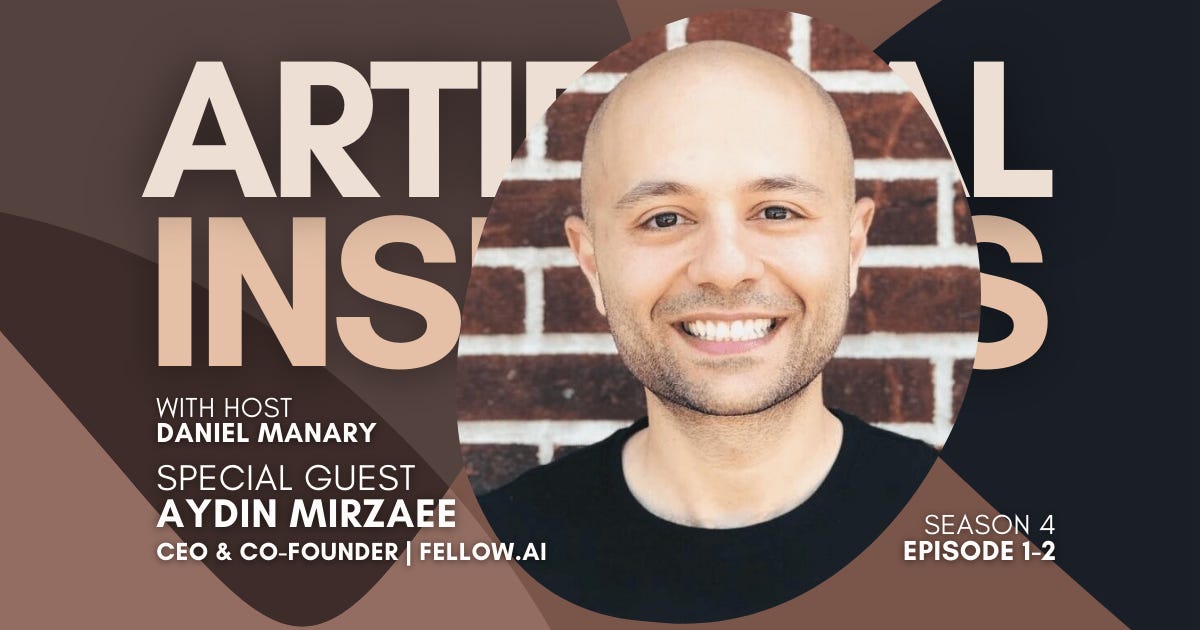
🎙️ Just Interviewed: Aydin Mirzaee on how AI can make everyone seem organized
Everything could be aided by AI and all of a sudden you could get the results without putting in the effort, which sounds like too good to be true, but like we’ve seen what AI can do, right?
AI makes a higher baseline of output feel normal, even for people who don’t naturally work in a disciplined, highly structured way.
In meetings, that’s easy to see. The organized 10-15% used to be the ones who wrote the agenda, captured decisions, and followed up. Now a system can do a lot of that. The result is a different minimum standard for clarity and follow-through.
And that’s pretty neat.
Aydin Mirzaee is the CEO and co-founder of Fellow, an AI meeting assistant designed to support teams before, during, and after meetings.
He has been building Fellow since 2019… and that matters because he lived through the pre-AI limitation of meeting tools—they actually work best only for people who are already organized.
The earliest version of Fellow worked extremely well, but only the most structured slice of a company used it. Everyone else wanted the outcomes of organization without the friction of doing the work.
AI changed the math. It made it possible to raise that baseline across the company, instead of relying on a few people dragging, sometimes reluctantly, everyone forward.
💡 One Core Insight: AI raises the floor, then changes what “good” looks like
Aydin gave us a recruiting example that, I think, really embodies that idea of “raising the floor”.
He described a recruiter who meets with candidates, decides someone is a fit, then uses Fellow’s “Ask Fellow” feature to generate a high-quality write-up to send to the customer.
He framed it this way: if you were placing the CEO of PepsiCo, you would write an exceptionally thoughtful and detailed email. For a smaller role, you wouldn’t be able to spend the same amount of time. With AI, you can write an exceptionally thoughtful and detailed email for a smaller role, too.
The floor is rising! 🌊
Not that AI makes people brilliant by default… But, when baseline work gets easier and better, teams and individuals can redirect effort toward judgment, prioritization, and accountability. You know, the important human stuff.
🔑 One Key Clip: Why most teams never get past “basic” AI
In the bonus episode, Aydin named what he sees as the real bottleneck to AI adoption: workflow change.
At the end of the day, success with AI isn’t about model quality or even access to the tech… it’s actually just change management.
He explained that most people can get surface-level value from AI tools quickly, but the deeper value requires rethinking how work gets done, and that’s hard to do under deadline pressure.
Does the following sound familiar?
You could finish the task the old way by Friday… or you could experiment with AI, spend more time upfront, and risk frustration or failure.
Most people usually say, “I’ll try it when I have more time.”
Organizations that want real gains have to intentionally create space without deadlines. That’s the only way new workflows emerge and teams (and people!) can grow.
The clip is short, but it explains why many AI tools stall at novelty. Raising the floor requires patience (sometimes lots of it) before it pays off.
🥡 One Takeaway: When AI removes the blank page
Daniel shared a thought after the interview that helped me name what felt different about this conversation.
Before Fellow became AI-first, running good meetings required a series of small creative decisions. What should the agenda look like? What mattered most in that call? What do we need to follow up on next time?
That kind of work rewards people who are comfortable with a blank page… while excluding the ones who may not be so comfortable.
What AI changes, as Daniel put it, is the type of decision being asked of us. Instead of inventing from scratch, we become editors. Instead of asking “What should this be?”, we’re asked “Is this right?”
I think it’s interesting.
Editing is cognitively easier than creating, after all. It lowers the barrier to participation. You can reject the agenda more easily than create one. You can tweak the follow-up more quickly than write one. You’re still making the decisions… just not starting from a blank page.
That feels like another version of the floor rising.
🥁 Up Next: Adeel Zaman on when AI leaves the screen
The next conversation pushes AI beyond meetings, documents, and software interfaces.
Daniel will be sitting down with Adeel Zaman, CTO and Co-Founder of DOZR, to explore what happens when AI begins to reason and act in the physical world. Adeel has moved from deep learning research to scaling startups, and now focuses on what he calls embodied intelligence. Real sci-fi stuff.
✨ Raising the floor without losing the human
I think when AI raises the baseline quality of everyday work, it changes who can participate, how decisions get made, and where human effort is best spent.
AI removes unnecessary friction.
That means fewer blank pages, fewer dropped threads, and more generally organized people. In the best case, this also means more space and room for more interesting human work.
And I think that’s pretty exciting.
As always, thanks for listening. 🙏

P.S. Artificial Insights is a podcast on how AI is changing work, life—and us. Every other Friday, Daniel Manary sits down with leaders, thinkers, and builders in AI to have candid conversations on what they’re doing right now and how they think the world will change. If you’re a podcast listener, we’d love for you to check us out!
P.P.S. If you liked the episode, please subscribe, share, and/or give the show a review on your favorite podcast player! Every little bit goes a long way. 😁
Artificial Insights is a part of the Manary.haus family ❤️ Come say hi!