


👋 Hey friends, Arianne here, editor and producer of Artificial Insights. Welcome to a special #TBT edition of TL;DL, where we revisit past interviews with fresh ears.
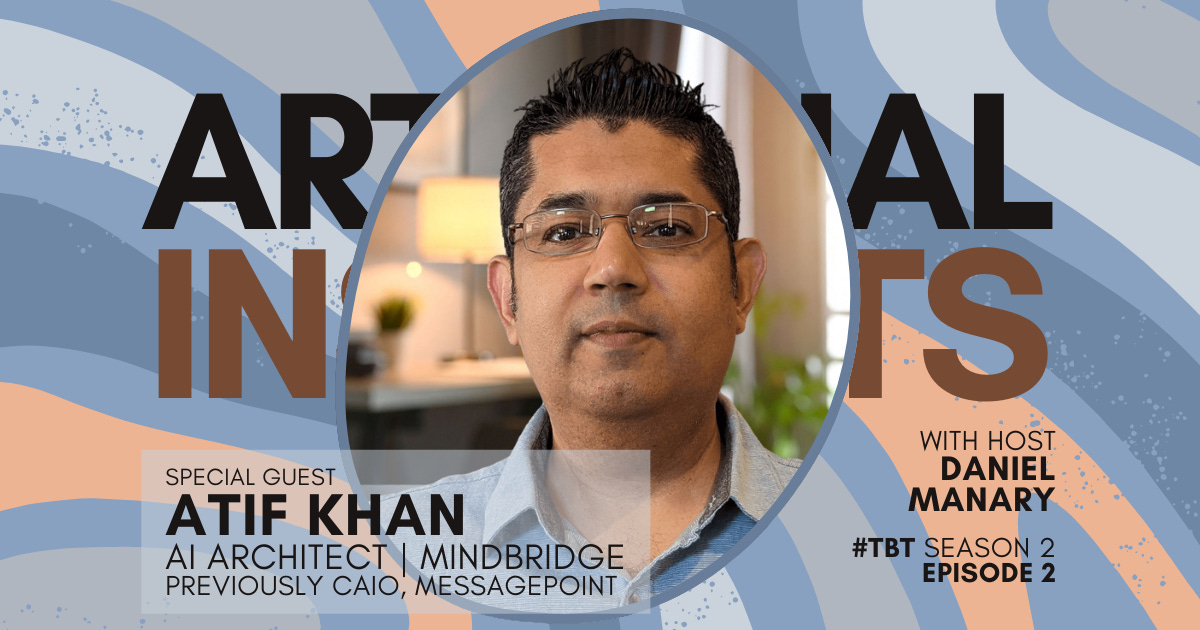
Today we’re rewinding to Season 2, Episode 2 with Atif Khan, who at the time was Chief AI Officer at Messagepoint, and who is now AI Architect at MindBridge, as well as a Data Growth Coach at Communitech.
Let’s get into it!
A year ago, “AI-first” meant something specific.
I mean, it still does.
I think most people just forgot.
Upon revisiting this, I realized how often we now use “AI-first” without defining it. Atif did a year ago, and in a way that still holds up.
🎙️ From the Archives: Atif Khan
“I organically grew in the industry as a software developer, computer scientist… and then went back to university… to understand not just the engineering part of things… but also what’s the science behind it.”
Atif lives at the seam between research and production. He cares about the theory, and he cares just as much about whether said theory survives contact with the real world.
One story he shared really stood out to me. A talented student joined his team and, within a week, was in tears.
“My classifier is not working.”
In class, the data had been clean. In the real world, it wasn’t. The theory was applied correctly, but the context she found herself in wasn’t what she expected… and she wasn’t trained to know how to compensate.
That gap between elegant theory and messy implementation is where most AI efforts stall. Atif’s message was poignant: understanding how something is built is only half the work. The other half is adapting it to reality.
💡 Core Insight: AI-First Is a Change in Expectations
In this episode, Atif defined “AI-first.”
If someone hands you a thousand numbers to add, you wouldn’t add them manually. You could, but that would be a very bad idea.
Instead, you’d use Excel because it compresses effort, removes friction, and would do it way more accurately and perfectly. “AI-first” is the next step. You show the machine the problem, and it returns not just the answer, but the reasoning behind it.
“Potentially it can look at those numbers. It can write a Python script in the background… give you the Python script so you can validate that this answer is correct, as well as give you an answer in real time.”
If your team had access to tools that compress cognitive effort, but your expectations haven’t changed, you are not AI-first. You are AI-enabled at best.
At Messagepoint, this became tangible. Copilot was rolled out to developers. They were not micromanaged in how to use it. Instead, the expected outcomes were adjusted.
“Less code reviews, more robust code… better coverage from unit testing… you can definitely measure each and every one of those on a daily basis with every commit.”
That is AI-first: a recalibration of what competent work looks like.
🎧 The full episode unpacks this mindset in more detail, and it’s worth revisiting.
🔑 Key Clip: Go Touch the Elephant
“There’s a story… people were taken to a dark room… and they had never seen an elephant before… everybody described the elephant differently.”
In the bonus episode, Atif uses this parable to describe AI. Depending on what you’ve touched, the beast looks different.
And then, he ups the stakes.
“This specific beast… it’s not just an elephant, it’s a dinosaur.”
Confusion, he argues, doesn’t go away by staying outside the room.
“We all have to go into the dark room and touch the elephant.”
And the barrier to entry is lower than ever.
“You don’t need to learn a programming language… you can literally just get on a browser, talk to it and get a feel for what it can do.”
What surprised Atif most over the last two years wasn’t that it could generate text, but that it could reflect.
“It’s going to be… at a point where it’s a cognitive companion.”
That phrase still stands out to me. AI not just as a text generator, but a cognitive companion. Something you can test ideas against, refine thinking with, and use to accelerate learning.
“I can potentially tap into the voice of many experts.”
And there’s no perfect time to start… or rather, any time is the perfect time to start.
So, the question is simple: have you stepped into the room yet?
🧭 One Year Later
Revisiting this conversation, what stood out to me, again, was the mindset shift that seemed required to wrap our heads around AI properly and correctly.
AI-first was never about hiring researchers or announcing a roadmap… it was about recognizing that cognition had become cheaper and adjusting your workflows accordingly.
If you say your company is AI-first, what changed in how you measure work?
That question still feels uncomfortable in the best way.
A year later, the tooling has improved and the headlines have multiplied, but the core insight remains the same.
“AI-first” isn’t just a feature roadmap, it’s a necessary change in expectations.
As always, thanks for listening. 🙏

P.S. Artificial Insights is a podcast on how AI is changing work, life—and us. Every other Friday, Daniel Manary sits down with leaders, thinkers, and builders in AI to have candid conversations on what they’re doing right now and how they think the world will change. If you’re a podcast listener, we’d love for you to check us out!
P.P.S. If you liked the episode, please subscribe, share, and or give the show 5 stars. Every little bit helps! ⭐
Artificial Insights is a part of the Manary.haus family ❤️ Come say hi!