


🤘 Hey friends, Arianne here, Editor and producer of Artificial Insights, the podcast. Welcome! This is TL;DL where I write about what stood out to me in each episode, share some food for thought, and do a roundup of what happened and what’s next for those of us who prefer to read.
Let’s get into it!
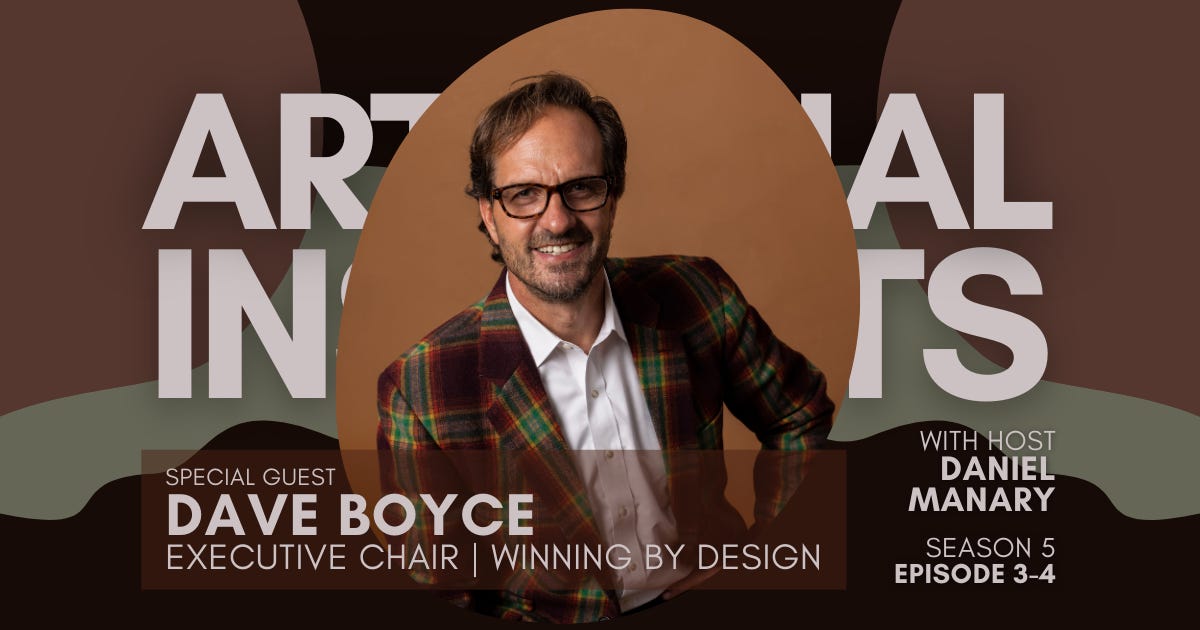
On the surface, this was a conversation about AI, growth, and go-to-market. Underneath it, though, was something more familiar. Dave Boyce has lived through multiple shifts that once felt just as destabilizing as this one: the early web, the rise of SaaS, the move from sales-led to product-led growth.
Each time, the tools changed.
Each time, the business models followed.
Each major shift in software eventually changed how companies acquired customers, where humans added value, and what kinds of roles actually scaled.
Now, AI is accelerating that process again.
🎙️ Just Interviewed: Dave Boyce on How AI Is Changing Go-To-Market Strategies & Business Models
“When I first started, we were hosting very large machine learning models in colo facilities, which eventually became known as the Cloud, inside a model that eventually became known as SaaS.”
Dave Boyce has been present at several moments that only get named clearly in hindsight.
He’s built and sold multiple SaaS companies across very different eras. One of them sold to Oracle. Another to Amazon. In between, he went from running businesses with average annual contracts of $1.2 million to building a company where the median ACV was closer to $1,200.
It was quite the whiplash.
Today, Dave works at Winning by Design, where he operates at a different altitude. He describes it as a “klick up” in perspective: instead of being heads-down inside one company, he now sees patterns across dozens of growth-stage businesses, many of them sitting comfortably at $50M to $2B in revenue… but also still worried about what comes next.
What makes his perspective especially useful right now is that he doesn’t talk about AI as a sudden rupture, but as another transition layered onto earlier ones. From sales-led to product-led. From high-touch to self-serve. From humans executing predictable work to humans focusing on judgment, coordination, and trust.
This episode pulls together those threads. Dave’s background gives him a long memory, and that memory shapes how he evaluates what is happening now.
If you want to hear Dave walk through this arc in his own words, from early SaaS to product-led growth to what AI unlocks next, the full interview is worth your time.
💡 One Core Insight: AI is the Continuation of the SaaS Revolution
One line from this conversation stayed with me while editing. Dave said, almost in passing:
“Everything’s changing again.”
Early in his career, Dave was building software before “the cloud” or “SaaS” were common language. Later, he had to reorient his thinking entirely when he moved from million-dollar enterprise contracts to a business where self-service was the only way the economics could work. Each shift forced a rethinking of how customers found products, how value was delivered, and where humans actually mattered.
Dave pointed out that over half of B2B purchases now begin with an LLM inquiry, and that most B2B buyers are millennials or Gen Z. The implication is structural, beyond behavioral: discovery, evaluation… even upgrading are increasingly happening without human intermediaries.
What struck me is how closely this mirrors earlier transitions. Each wave of software maturity pushed more work into the product itself. Each time, humans moved upstream, toward less execution, but more judgment and more responsibility for edge cases and trust.
Dave is careful not to overclaim. Growth curves are real, but we’re still early in the game. We do not yet know which AI-native companies will compound sustainably and which will hit familiar headwinds. Like he says, the laws of physics have not disappeared. What has changed is where friction lives.
🔑 One Key Clip: What AI Can’t Replace
“AI is not gonna take our jobs as long as we are not trying to hold onto a job that AI should have.”
This clip stood out to me because it names the fear many people are carrying right now without dismissing it.
Dave started by acknowledging how reasonable that anxiety is. If your livelihood supports other people, it makes sense to feel unsettled when the ground starts shifting.
But, he did something important: he separated jobs from being human.
Order processing, routine execution, and predictable workflows are exactly the kinds of things AI will absorb. And I’d argue, are exactly the kinds of things AI should absorb.
Holding onto those tasks as the core of your identity is where the existential angst is coming from.
Simultaneously, Dave drew a clear line around the work that doesn’t transfer so easily: managing uncertainty, aligning stakeholders, building confidence, helping people navigate ambiguity... making connections between humans. These aren’t fallback skills—they’re the work that remains once the predictable parts are automated.
I really appreciated how practical this framing was, and how honest it was. It doesn’t deny displacement, but encourages us all to “Lean into the upper half realm of your job” and let AI take the rest. In that version of the future, automation is just a narrowing toward the work only humans can do.
If this question is already close to home for you or your team, the clip is worth a listen.
🥡 One Takeaway: What Work Are You Protecting?
What this conversation surfaced for me is how often fear shows up around tasks, not purpose.
The problem, as it turns out, is that we keep defining our value around work that was already on its way out.
That raises an uncomfortable question, especially for leaders and operators:
Which parts of your role are you actually trying to protect?
Not your title. Not your team size.
The day-to-day work you spend the most energy defending.
Is it the reports you always write yourself? The approvals that always run through you? The processes that make you feel indispensable because they are slow, manual, or hard to explain? Those are often the first places AI fits, and the hardest places for people to release.
Dave recommended that we let go of the predictable work, and instead step into judgment, alignment, and responsibility for outcomes. It’s uncomfortable and new, but where growth can actually happen.
So here’s the question I’m sitting with after this episode:
💬 Which parts of your work feel hardest to let go of right now, even if you know they probably should be automated?
I’d love to hear how you’re thinking about that in the comments.
🥁 Up Next: Julie Trelstad on AI and Book Publishing
Julie Trelstad has spent more than 30 years in book publishing, riding wave after wave of technology… from desktop publishing to eBooks to print-on-demand. Now she’s working on what comes next: how creators prove ownership, license “AI rights,” and stay discoverable in a world where copying and imitation can happen at internet speed.
Up next, Daniel Manary and Julie Trelstad will be having a conversation about the infrastructure layer in publishing most people don’t get the chance to see: content fingerprinting, rights markets, and the emerging economics of training, research, and generative use. It also gets practical about the tension creators are living in right now: protecting work without locking it away.
✨ When Business Models Shift
One of the threads running through this episode is that business models don’t change simply because people get excited… they change because friction moves.
The web changed distribution.
SaaS changed delivery and pricing.
Product-led growth changed how customers enter the system.
AI is pressurizing the next set of assumptions, especially what gets handled by software, what gets handled by humans, and what work is worth paying for.
Personally, I’m pretty excited to see where things go!
As always, thanks for listening. 🙏

P.S. Artificial Insights is a podcast on how AI is changing work, life—and us. Every other Friday, Daniel Manary sits down with leaders, thinkers, and builders in AI to have candid conversations on what they’re doing right now and how they think the world will change. If you’re a podcast listener, we’d love for you to check us out!
P.P.S. If you liked the episode, please subscribe, share, and or give the show 5 stars. Every little bit helps! ⭐
Artificial Insights is a part of the Manary.haus family ❤️ Come say hi!