


👋 Hey friends, Arianne here, editor and producer of Artificial Insights. Welcome! Who else is ready for the weather to pick something already?
This is TL;DL where I write about what stood out to me in each episode, share some food for thought, and share what’s next… for those of us who prefer to read.
🤗 Today, we’re spending time with one of our favorite people!
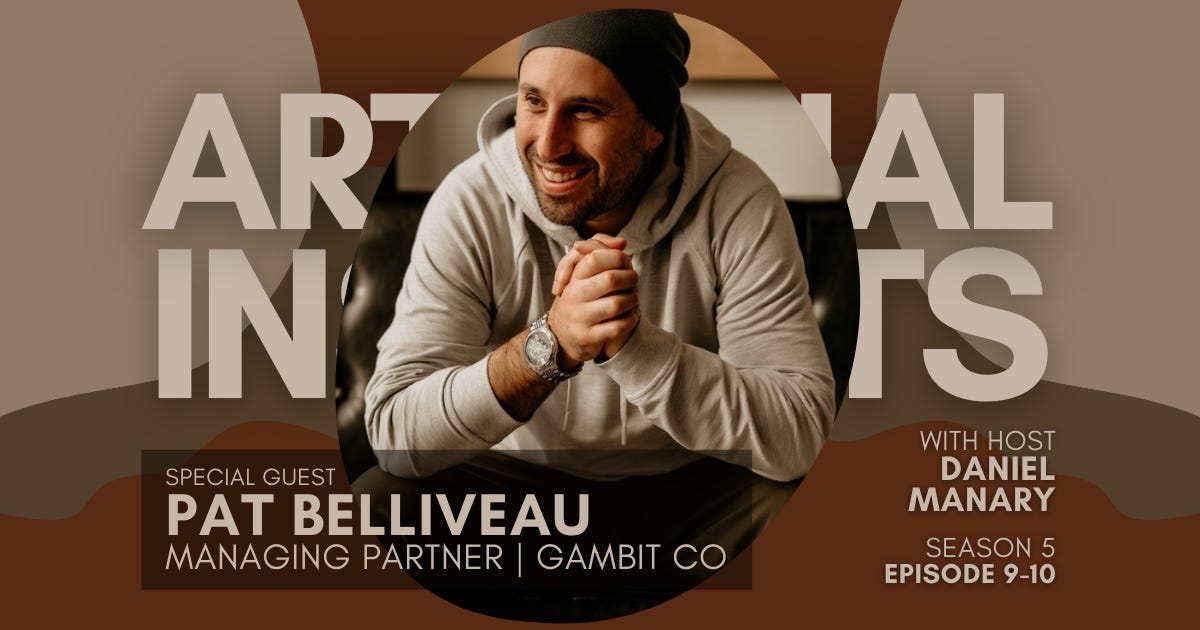
I really like getting to hear from people who’re willing to say what’s actually hard. Pat Belliveau is one of those people. He’s candid, practical, and really generous about sharing what he’s learned.
We really appreciate that about him!
We like him so much, this is the second time he’s been on the show! The first time we interviewed him was almost exactly one year ago. And it’s been fun to watch him and his company grow this whole time.
🎙 Just Interviewed: Pat Belliveau on Why Getting AI to Work Once Is the Easy Part
“Anybody can get an AI to do something once. That’s not hard. But to get it to do it twice, three times, four times, and repeatable and reliable...”
Pat Belliveau is the managing partner at Gambit Co, where he and his team build applied AI systems for real business workflows. Throughout this interview, Pat repeatedly talked about reliability, trust, and the discipline required to make AI useful beyond the prototype stage.
He’s also one of those guests who’s willing to say what many people avoid saying out loud:
The hard part isn’t successfully getting a flashy result with AI. That’s actually super easy, especially nowadays. The real hard part is making that flashy thing happen more than once.
You know, beyond the demo.
Listen to Daniel and Pat get into what changed for Gambit between year one and year two, why retainer relationships unlocked better work, and how Pat thinks about solving one real problem at a time.
💡 One Core Insight: AI Gets Hard in Production
AI gets much harder the moment it has to fit inside an actual workflow.
It’s one thing to show that a model can produce a result… Turns out, it’s a whole other thing entirely to make that result reliable, explainable, and useful at scale.
The real work starts when AI has to survive messy documents, repeated use, human review, edge cases, and the expectations of a business that can’t afford surprises.
A prototype can create excitement quickly. That’s why they’re helpful! It can help people imagine what might be possible, and people need all the help they can get with their imaginations. But, production is where all the hidden complexity shows up. Suddenly, the question becomes, can this stochastically-determined AI system do that really amazing thing again, with the same result, tomorrow and the day after tomorrow? Does the team understand what the AI is doing enough to be able to verify it? Can they trust it enough to build a real, business-critical process around it?
Pat never talked about all this in abstract terms. He’s currently building in the middle of it and he distinguishes between a promising prototype and something that can actually hold up in production. That gap between impressive and dependable is where the hard work lives.
🔑 One Key Clip: Start Small Enough to Earn Trust
“Find something small, simple that you can crush. Use it as a use case.”
In the bonus episode, Daniel asks Pat what he would do if he were starting an AI consultancy from scratch today. Pat’s answer? Do something small, useful, and real for someone already in your network.
Then, turn that win into a case study, document what changed, and ask who else could benefit from the same kind of solution. Maybe it’s a logistics workflow, or its document extraction (who doesn’t use documents?). Maybe it’s something that’s only sort of adjacent. The point is to find the layer of the problem that applies beyond one organization.
AI is a low-trust market (anyone else feel like there are a few too many “experts” with 40 years of experience with ChatGPT?), and in a low-trust market, you can’t begin with big promises. You have to begin by solving one visible problem well enough so that people can see the value for themselves. Then, you let that story open the next door.
The short clip is worth it for anyone thinking about AI and business.
🥡 Food For Thought: Where Is the Real Friction in Your Workflow?
AI can probably do whatever you’re wondering about right now. It might take some work to set up, but it’s usually possible to figure it out.
The more interesting question is, “Where is the friction, and what would change if this step became easier, faster, or more consistent?”
It’s so easy to get distracted by tools, features, and demos. But, what’s the actual work people are trying to get done? What’s the real bottleneck? What’s repetitive? What’s slowing the team down? What’s creating drag in the process?
Those questions change the starting point. The answer might not always be flashy, but if you start looking for the part of the workflow that’s most ready to improve, you can get an ROI much more reliably and much faster.
Sometimes that means cost savings, sometimes it means speed... sometimes it means just giving a team more room to focus on the work that actually requires a human (i.e. not data entry).
I’d love to know how you think about this in your own work: when you look at your team’s workflows, where do you see the most friction right now? What would change if that part suddenly became easier?
👇 Let’s chat in the comments!
🥁 Up Next: March Break Student Special
Next, we’re doing a March Break special!
(Even if it is arriving just after March Break 😅.)
First, we’ll be revisiting Pat Belliveau’s bonus episode from Season 1 on AI in schools, and on the ways school systems may be falling short of what students actually need right now. Even though it was recorded a whole year ago, it’s still poignant now… and that’s kind of sad.
Then, next week, we’ll share a set of short interviews with high school students about their day-to-day experiences with AI, what they think about it, and how they see it shaping their future.
I’m especially excited about those episodes! We hear a lot about students when people talk about AI, but not nearly enough from them. Getting to hear their perspective directly feels important, timely, and honestly just really needed.
Follow the podcast so you don’t miss the special episodes, and subscribe to the newsletter if you want the summary in your inbox next week!
✨ The Future of AI Will Belong to What Holds Up
This podcast exists to stand at the gate of businesses using AI, separating hype from lasting impact. One of the clearest ways to tell the difference is reliability.
A flashy result can get attention, but a tool that keeps working inside a real workflow is something else entirely. That’s where trust is built and where teams start to believe AI might actually deserve a place in how they work.
If you know someone who is building AI carefully, thoughtfully, and with real operational stakes, we would love to hear from them!
As always, thanks for listening! 🙏

P.S. Artificial Insights is a podcast on how AI is changing work, life—and us. Every other Friday, Daniel Manary sits down with leaders, thinkers, and builders in AI to have candid conversations on what they’re doing right now and how they think the world will change. If you’re a podcast listener, we’d love for you to check us out!
P.P.S. If you liked the episode, please subscribe, share, and or give the show 5 stars. Every little bit helps! ⭐
Artificial Insights is a part of the Manary.haus family ❤️ Come say hi!