


🎉 Hello! Arianne here, editor and producer of Artificial Insights. Welcome to a special #TBT edition of TL;DL where we go back into the archives and revisit past interviews.
This one is from Season 2, Episode 5, with Alex Millar, co-founder and CTO of GovAI, and previously the co-founder of Bonfire, a procurement platform built for government. First released almost exactly a year ago.
Let’s look into it! 👓
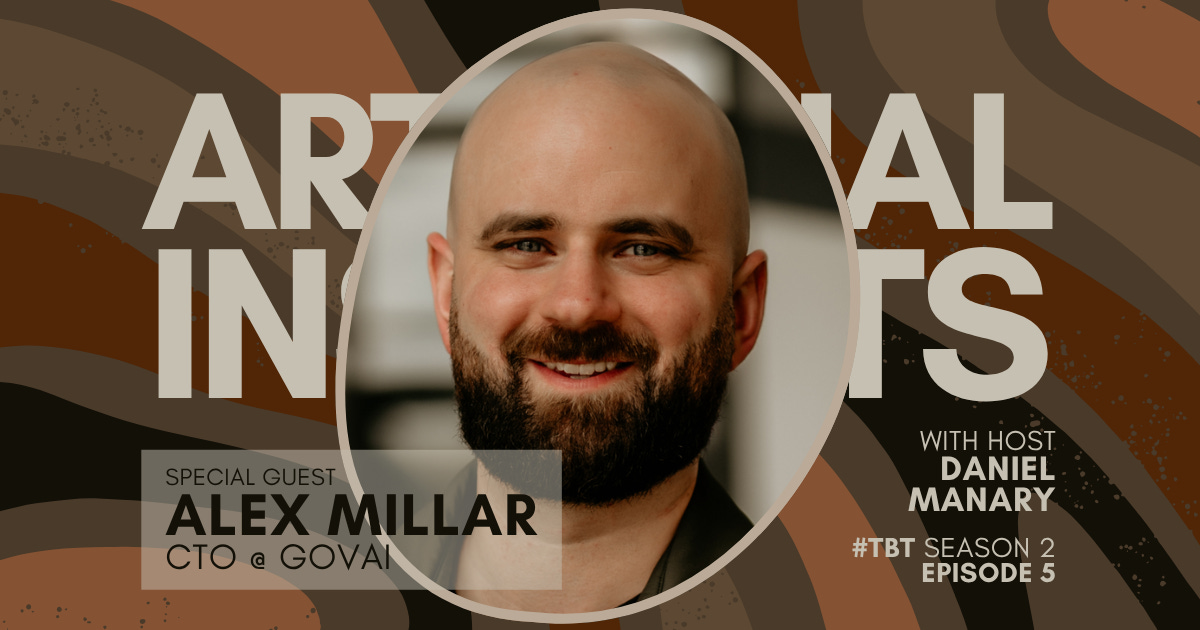
When Daniel Manary first spoke with Alex, people were already arguing about whether AI products were “real” products or just wrappers around foundation models. That question still floats around a lot today, surprisingly enough, and I appreciated that Alex didn't just stop there.
He challenged: is that really the interesting question to ask?
🎙 From the Archives: Alex Millar on How Everything Is A Wrapper
“Well, technically everything’s a wrapper.”
The question was simple: how does a product stand on its own if it's just a ChatGPT wrapper? An app that changes the way you interact with ChatGPT… but still, fundamentally, is just ChatGPT under the hood.
Alex's answer made me laugh out loud (and not figuratively). 😂
Yes, a product may wrap a model. But, if you think about it, every SaaS app out there is also just a web interface that’s a wrapper to a database somewhere. The real interesting question is whether the app enables more value than the raw underlying capability would on its own.
For a product to do that, it means doing the work to understand the niche well enough to know what the buyer needs around the AI itself.
In Alex’s case, that included things like privacy controls, acceptable use policies, PII detection and redaction, SSO, staff training, peer groups, and pricing that works for a city budget instead of a generic per-seat SaaS motion.
Today, a lot of AI discussion still stays at the level of capability. You know, can the model do this? Can it retrieve that? Can it call tools? Can it act agentically?
But, in reality, buyers care more about purchasing something they can roll out, govern, budget for, explain internally, and trust enough to keep using… rather than the raw list of features and capabilities.
💡 One Core Insight: The Product Is the Fit
One of the parts that stood out the most to me was Alex’s point that positioning and offering are part of the product.
Those are often seen as marketing terms, but really, they're more fundamental.
He gave a very practical example with pricing. Instead of charging per user, GovAI was working from a flat-fee model based roughly on city size and employee count. He learned that a city needs fixed costs. A city also doesn't want to decide which staff get access and which staff don't. That's just an overhead nightmare.
The pricing was part of product judgment that became part of their unique value proposition.
Same with the way he described training and peer groups. And, same with the way he talked about serving a niche tightly enough that you can identify common workflows and put useful rails around them.
Product strength often shows up in the surrounding decisions, not just in the model choice or the interface.
If you are building in AI right now, that still feels like a very useful filter:
Are you just shipping a capability? Or, are you shaping something people in a specific context can adopt?
🔑 One Key Clip: A Great Product Still Has to Make a Noise
“But at the end of the day, if you have a great product and no one knows about it, does the product even exist?”
In the bonus episode, Alex said something I think a lot of technical founders need to hear.
Yes, you have to build something that genuinely resonates with people and delivers value. But, that's only half the battle.
You also have to figure out how to tell people about it and get it into their hands.
A lot of technical people are comfortable with that first half and uncomfortable with the second. They want the product to speak for itself. They hope a good build will naturally get discovered. Sadly, that's not how it works.
That felt especially relevant in the context of AI, where new products appear constantly and where the market is crowded with demos, launches, experiments, and noise.
A useful product, no matter how innovative, still needs distribution, timing, and sales and marketing that fit the stage of the company… just like every other business.
🕔 One Year Later
The part that still stands out to me now is how grounded Alex’s framework was.
He wasn’t talking as though the hard part was having access to the model or the tech. He made it clear the hard part was understanding the buyer, shaping the offer, handling the edge cases, and building something people could actually adopt.
And after all this time, and all the other conversations we've had with other founders and builders… that still feels… right.
It seems that a lot of strong AI product thinking looks pretty ordinary from the outside. It looks like pricing choices, rollout choices, training choices, workflow choices, and careful decisions about what to support now versus later.
That may not be the flashiest part of AI… but it may just be the most valuable.
As always, thanks for listening. 🙏

P.S. Artificial Insights is a podcast on how AI is changing work, life—and us. Every other Friday, Daniel Manary sits down with leaders, thinkers, and builders in AI to have candid conversations on what they’re doing right now and how they think the world will change. If you’re a podcast listener, we’d love for you to check us out!
P.P.S. If you liked the episode, please subscribe, share, and or give the show 5 stars. Every little bit helps! ⭐
Artificial Insights is a part of the Manary.haus family ❤️ Come say hi!