


👋 Hey friends, Arianne here, editor and producer of Artificial Insights. Welcome to a special #TBT edition of TL;DL where we go back into our archives and revisit past interviews.
This one is from Season 2, Episode 3, with Jennifer Moss, an international speaker and the author of Why Are We Here?.
🤩 Let’s get to it!
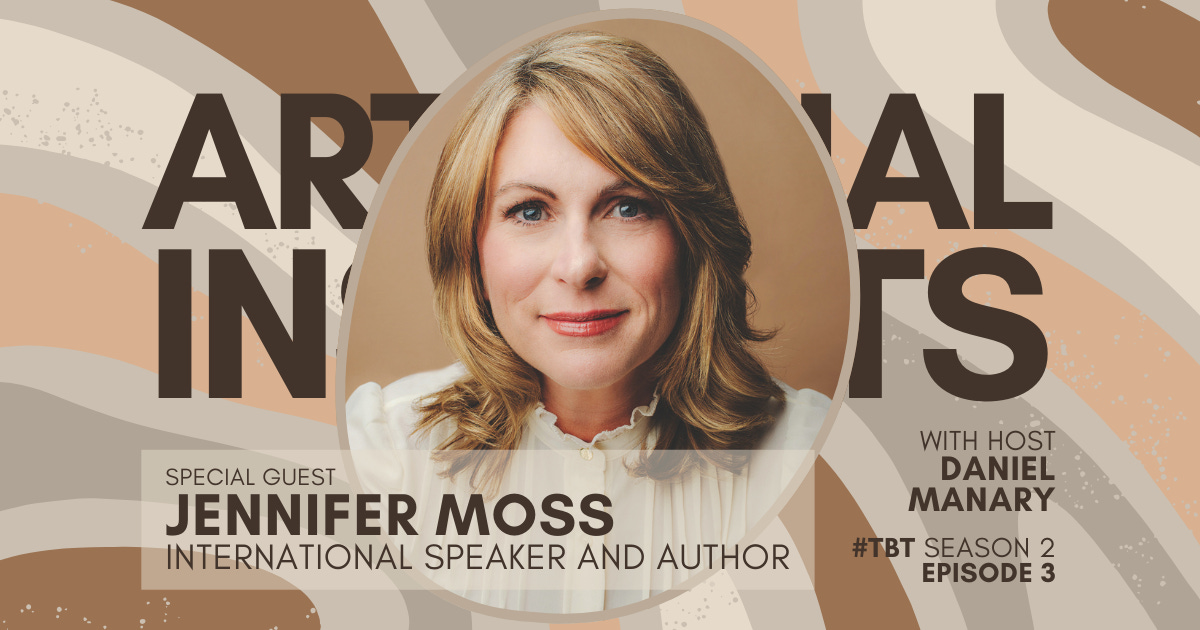
Some conversations were recorded in a different season of life, but we can still feel the weather in them today. When Daniel Manary first spoke with Jennifer, AI still felt brand new to many people, and “AI Anxiety” was a new term going around.
Today, it feels simultaneously like things have and haven’t changed at all.
🎙 From the Archives: Jennifer Moss on The Post-Pandemic Multiverse of Work
“We’re in the multiverse of work. We’re not in the future of work. We’re in a whole different timeline.”
Jennifer Moss is an award-winning journalist, a Harvard Business Review columnist, and a globally recognized voice on workplace wellbeing and leadership. She’s written The Burnout Epidemic and Why Are We Here?, and she’s spent years doing the kind of work most of us don’t have the time or access to do: interviewing widely, reading deeply, and tracing patterns across what employees, executives, and researchers are all seeing at the same time.
I particularly liked this episode because she came at the conversation as a workplace culture person, not an “AI person”, who kept getting pulled into AI conversations because the human effects were showing up everywhere.
Like she just couldn’t escape it.
I suppose, no one could.
In the episode, she talked about how the pandemic changed the baseline for how people relate to work, why “why am I here?” became more than a passing thought for so many, and why leaders kept reaching for the wrong levers when they felt the pressure to move fast.
It was fun!
💡 One Core Insight: We’re All Still Living in The Aftershocks of the Pandemic
This interview was released almost exactly a year ago… and yet, I think everything that was said then still holds true. Especially the bit about how we’re in a “multiverse of work”.
(Still one of my favorite clips. 😊)
We didn’t return to the old timeline after 2020. A lot of people changed how they personally related to work, meaning, and time, and they did it in the middle of shared loss, shared grief, and the unsettling awareness that normal life can disappear suddenly and unceremoniously.
We all had to rethink life in the unsettling company of mortality salience.
As a society, we were forced to face the finitude of life, and when that happened, it created stress, reactivity, and polarization for some, and a deeper pull toward meaning and impact for others. In other words, the pandemic shaped what people tolerated, what they prioritized, and what started to feel pointless.
In the main episode, Jennifer connected this to why so many people made big career moves, why the “why am I here?” question became persistent, and why it’s naïve to treat the pandemic like a thing we can simply put in the rearview mirror.
Jennifer made the observation that many workplaces are still trying to solve today’s morale and engagement problems with pre-2020 instincts. They tighten the rules, increase visibility, reassert control, push speed and urgency as a substitute for clarity.
However, mortality salience changes the context people are bringing into work. When someone has been shaken awake to “life is short”, they don’t automatically snap back into old patterns just because a mandate says it’s time. Unconsciously or not, they start looking for purpose, they start measuring leaders differently, and they start asking harder questions about whether work is fuel or just grind.
AI landed in the middle of all that… as an accelerant. If leaders treat AI adoption as a race, while workers are still navigating a deepened sensitivity to meaning, safety, and direction, it creates the conditions for disengagement that looks like laziness from far away and feels like self-protection from the inside.
If you’ve been wondering about “AI Anxiety”, “FOBO”, and why engagement at work is at an all-time low and hopelessness is at an all-time high, the full episode explores all of that and includes some practical ideas on what to do.
🔑 One Key Clip: How AI Turned Into a Race Before It Became a Plan
The bonus clip is a tight explanation of why so many AI rollouts feel frantic.
Jennifer shared a surprising data point: in 2019, technology wasn’t even in the top six disruptors CEOs were most worried about. Then, in 2020, it finally showed up on the list. Within two years, it shot up to number one.
That shift illuminated a specific kind of executive pressure:
“We can’t get behind.”
Jennifer described the push and pull she saw inside leadership teams. On one side, urgency and competitiveness. On the other side, a quiet admission that the fundamentals were missing:
“I don’t really have a strategy.”
“I don’t really have a plan.”
“I don’t really have a communication strategy.”
And employees felt that absence immediately—they felt the adoption pressure, but they didn’t hear a coherent story about what changed, what stayed, and how people would be supported through the transition.
Jennifer pointed out that the uncertainty became a subtle, persistent force. If people stopped seeing themselves in the future of an organization, hopefulness dropped, and employees didn’t see a point to being loyal or engaged.
She also named the missed opportunity: AI was supposed to remove the mundane tasks and open room for more meaningful work. But you can’t just automate someone’s tasks and call it progress if you don’t redesign the role and invest in upskilling.
Where was all the meaningful work that we were promised?
🕔 One Year Later
It’s been a whole year, and yet, if you look at the world… things haven’t really changed.
Many teams are still living with the aftershocks Jennifer described. Mortality salience didn’t actually evaporate when restrictions ended—people still feel that low-grade awareness that life is finite, and there is still a tangible sense of existential angst.
I think that might be why Matt Schumer’s viral essay “Something Big Is Happening” hit everyone the way it did. It framed this current “AI moment” as “February 2020 again”, with AI as the incoming wave, and it tells people to prepare for job disruption fast or be hit unawares like most of the world in 2020.
It’s almost a little triggering.
But panic isn’t a strategy. If leadership can’t explain what AI is for, what changes in real jobs, and how people will be supported, workers interpret “move fast” as “you’re on your own”.
And more than anything else, that’s just a surefire to get AI Anxiety, Fear of Becoming Obsolete, and disengagement, even in high-performing teams.
As always, thanks for listening. 🙏

P.S. Artificial Insights is a podcast on how AI is changing work, life—and us. Every other Friday, Daniel Manary sits down with leaders, thinkers, and builders in AI to have candid conversations on what they’re doing right now and how they think the world will change. If you’re a podcast listener, we’d love for you to check us out!
P.P.S. If you liked the episode, please subscribe, share, and or give the show 5 stars. Every little bit helps! ⭐
Artificial Insights is a part of the Manary.haus family ❤️ Come say hi!