


🙋♀️ Hello! Arianne here, editor and producer of Artificial Insights, the podcast where we talk to thinkers and leaders in AI about how it’s changing work, life… and us. Welcome! This is TL;DL where I write about what stood out to me in each episode, share some food for thought, and do a roundup of what happened and what’s next for those of us who prefer to read.
Let’s dig into it! 🦺
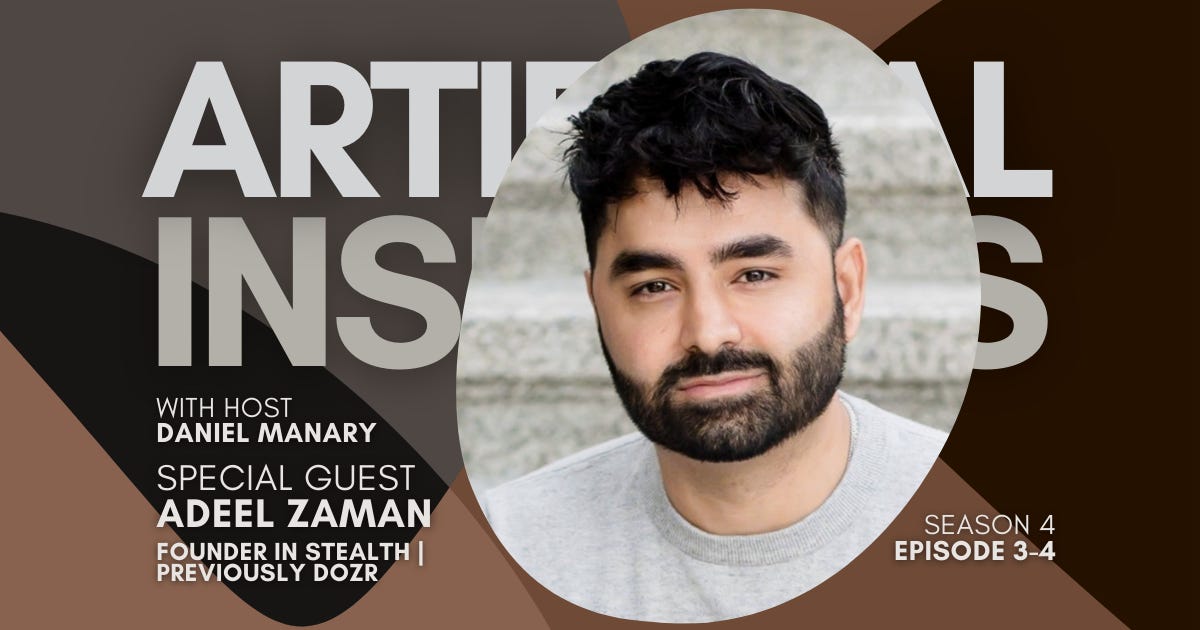
This episode was a really fun one and it made me (briefly) wonder if we’re in a sci-fi world now.
Don’t you just love it when interviews stretch your imagination?
See, when we talk about AI progress, we usually stay in the realm of screens, text, and software. But, what does intelligence look like when it has to act in the physical world, not just describe it?
Did you know that it’s possible?
🎙️ Just Interviewed: Adeel Zaman on giving AI bodies
You’d be surprised, if we walked into manufacturing facilities, into construction job sites, in any kind of physical space, and see how much of it is done by machine learning.
And it’s a very, very small percentage.
And I think, arguably, it’s probably one of the biggest unlocks we can do to improve our standard of living as a society.
Adeel Zaman entered the University of Waterloo at sixteen, earned national recognition in math and programming, and later co-founded DOZR, scaling it into a $40M+ construction marketplace across Canada. After years in deep learning research and startup building, he stepped back to start again. Something he admitted was difficult to do!
And this time, his focus wasn’t software tools or dashboards… it was excavators.
In the interview, Adeel described working on what he calls “embodied intelligence”. AI systems that can see, reason, and act in the physical world. He started with construction equipment like excavators and skid steers, machines that already sit at the foundation of real-world work.
What made this conversation compelling was how grounded Adeel’s thinking stayed (haha, see what I did there?). He spoke openly about cost, learning constraints, safety, and the long road between today’s models and anything resembling general intelligence.
He also talked about real-life, talking mechs. Seriously. Check it out.
💡 One Core Insight: Embodied intelligence may be a prerequisite for AGI
Adeel questioned something that a lot of AI enthusiasts and optimists take for granted—can we actually reach something like a capable “white-collar worker” AI using the knowledge-only training we do today.
Like, actually.
Today’s models excel at question answering and short tasks. But long-horizon work, whether physical or digital, requires understanding context, constraints, and consequences over time.
Think about it: humans don’t learn about the world only through language. We learn by acting in it, by bumping into limits, by adjusting after mistakes, by potentially crying a little when it hurts.
Adeel suggested that grounding AI in physical interaction may not just help robotics, it might help intelligence itself generalize more reliably.
I admit, the thought made me think of The Terminator and may have gave me goosebumps. Just maybe.
He pointed to research showing that mixing very different kinds of data can improve performance across tasks. Poetry and code. Vision and language. In the same way, learning to move objects, navigate space, and respond to feedback could shape internal representations that pure text cannot.
Don’t get me wrong. The takeaway isn’t so much that humanoid robots are imminent. It’s more that embodiment might be the missing ingredient for the kind of reasoning we keep asking current AI models to do.
🔑 One Key Clip: Why “why now” matters more than vision
In the bonus clip, Adeel explained how he evaluates whether an idea is worth building now by sharing a story about Jeff Bezos in 1995.
Bezos saw that the Internet existed, and he saw that usage growth was exploding. And he acted on it before anyone knew where it was going.
He was able to see that usage growth made a new category of companies viable, even if much of the infrastructure was still immature. Books weren’t necessarily the end goal, but they were the right shape for that moment in time.
Check out the clip to be inspired!
🥡 One Takeaway: Intelligence needs a body, but safety needs intelligence
AI systems are powerful, but disembodied.
Robots are embodied… but, technically, unaware.
That gap is why industrial robots remain isolated and unsafe to work alongside.
Yes, the labor shortages Adeel and Daniel discussed weren’t abstract—they’re already visible across construction and skilled trades in North America, and more severe in places like South Korea.
We know robots are going to be helpful, probably inevitable, but are we willing to trust them around people? Should we be? And, what would it take?
🥁 Up Next: Josh Müller on how AI can change what’s possible
In the next episode, Daniel is speaking with Josh Müller, director at the tech nonprofit Waha, about what it looks like to apply AI under real operational, ethical, and theological constraints.
If you’re working in nonprofits, missions, or any environment where people’s safety and security matter more than convenience, this episode offered a real look at how AI can be used carefully, practically, and well.
✨ When intelligence meets the real world
This interview made me realize that the next frontier of intelligence isn’t going to come about simply because we’ve fed more human knowledge and data into our AI models.
We’re going to need to place that intelligence in the physical world eventually.
I don’t know about you, but that leaves me feeling simultaneously excited and uncomfortable.
As always, thanks for listening. 🙏

P.S. Artificial Insights is a podcast on how AI is changing work, life—and us. Every other Friday, Daniel Manary sits down with leaders, thinkers, and builders in AI to have candid conversations on what they’re doing right now and how they think the world will change. If you’re a podcast listener, we’d love for you to check us out!
P.P.S. If you liked the episode, please subscribe, share, and/or give the show a review on your favorite podcast player. Every little bit goes a long way. 😁
Artificial Insights is a part of the Manary.haus family ❤️ Come say hi!