


🏄♀️ G’day! Arianne here, editor and producer of Artificial Insights, the podcast. Welcome! This is TL;DL where I write about what stood out to me in each episode, share some food for thought, and do a roundup of what happened and what’s next for those of us who prefer to read.
Surf’s up!
(No this episode has nothing to do with surfing. I’m just feeling nautical today. Maybe because our guest is based in Australia?)
Lately I’ve been noticing how often “AI” gets blamed for things. You know: a confusing email, a weird slide deck, a design that feels off but no one wants to own.
Somewhere along the line, “the AI did it” has become a convenient shrug like it’s acceptable or something.
(It isn’t.)
This interview went in the opposite direction.
Instead of treating AI as something to hide behind, Ahmad talked about what it makes possible when it’s used with intention. After all, at its best, AI should actually help someone express what they were trying to say in the first place.
It should enable creativity. Not inhibit it.
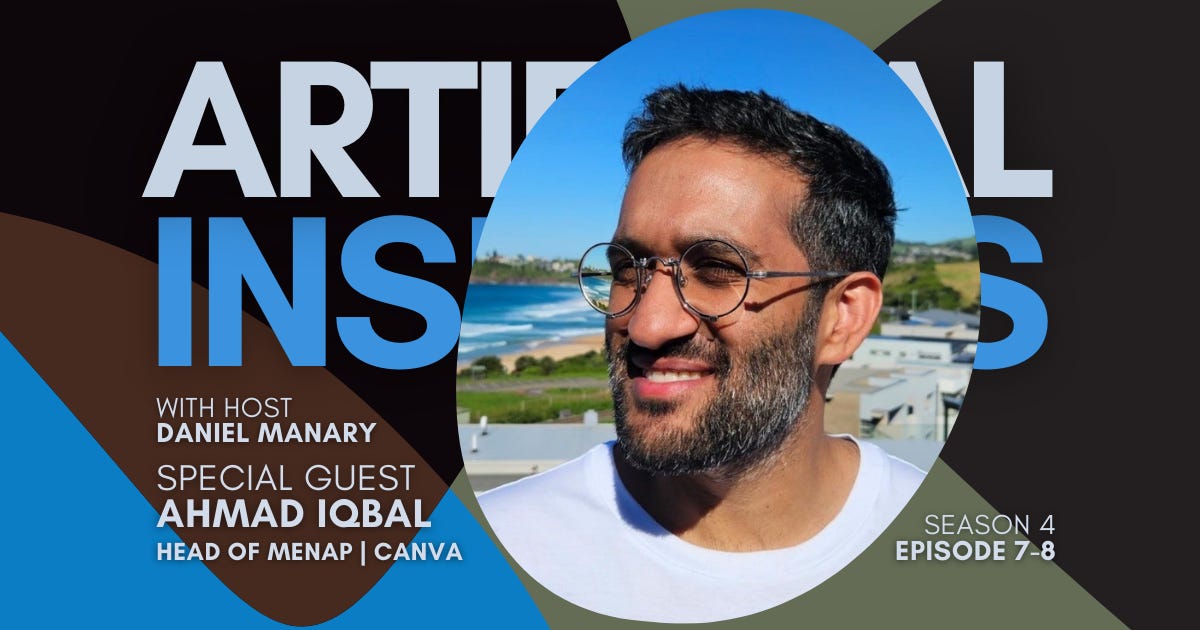
🎙️ Just Interviewed: Ahmad Iqbal on how AI can make things delightful
I was actually approaching it like, this could be really delightful, where they just click this Magic Write button.
Ahmad Iqbal was AI product lead at Canva, now head of MENAP. He was Canva’s first generative AI product manager and led the company’s earliest gen AI features before most teams had even decided what “AI strategy” meant.
I really loved how unceremonious the origin story was.
He didn’t start with a roadmap, or a productivity metric, or a mandate to ship AI features. He started with a feeling. What would it be like if a user clicked a button and felt… well, delighted?
That instinct makes more sense once you hear how Ahmad talks about Canva’s product philosophy. Accessibility not as a layer on top, but as the entire point. If a tool feels intimidating or confusing, it doesn’t matter how powerful it is, it’s out.
Throughout the conversation, Ahmad kept returning to that idea. AI, in his mind, earns its place when it lowers the barrier between what someone wants to say and what they’re able to create.
That perspective shaped how Canva approached generative AI from the beginning, and it shows up in how Ahmad thinks about everything from design tools to education.
💡 One Core Insight: Accessibility is the real AI strategy
Canva has always been built around the idea that creative tools should invite people in, not screen them out. If a product requires specialized training before someone feels competent, most people will never get far enough to enjoy it. Simplicity is about removing unnecessary friction.
Ahmad described AI as the next step in that same arc.
We see AI as decreasing the level of competency and capacity you need to design.
He talked about his young son trying to draw a Ninja Turtle. The desire is there, the imagination is there, and the story is there. What’s missing is the fine motor control and vocabulary.
(Hey, I relate!)
AI, in that framing, isn’t about replacing creativity by making things easier to do or make, it’s about helping someone get past the mechanical barriers that keep ideas stuck in their head.
Instead of asking how fast something can be produced, the better question becomes: who can now participate?
For product teams, this has real implications. If AI lowers the barrier to creation, then the work shifts from teaching users how to operate tools to helping them communicate intent. That changes onboarding, guardrails, and what success actually looks like.
🔑 One Key Clip: When the medium changes, behavior follows
In this bonus episode, Ahmad frames AI through the work of Marshall McLuhan, the Canadian scholar known for the line “the medium is the message”.
See, today, we’re still treating AI like a container for old formats.
Radio started as someone reading the newspaper. Television started as filmed radio. Only later did each medium find what it was actually good at. Music, call-ins, sitcoms, new genres… new habits.
(Could anyone really have predicted the present-day TV-at-the-center living room?)
Ahmad thinks AI is still in that early phase.
People are using AI to make [things] better or faster, but they’re still making the same thing[s].
The real shift will happen when we stop forcing AI to imitate existing workflows and start paying attention to what new behaviors it enables. Then, it’ll really be magic. 🧙♂️
🥡 One Takeaway: If AI is the medium, what happens to work?
On LinkedIn, Daniel pointed out that AI is different in one important way. Unlike television, AI is a two-way medium. We don’t just consume it, we talk to it. And most of what we talk about is work.
If AI becomes the medium through which we understand, decide, and delegate work, then work itself may become conversation-first. Less about producing artifacts, and more about judgment, coordination, and meaning.
Or, we could use the same medium to strip humans out of work entirely.
What do you think will happen?
🥁 Up Next: Alex Maier on using AI to get you on the water
Most AI products stop at “ask the bot a question”. onWater is built around something more practical: helping people act.
In the next episode, Daniel talks with Alex Maier, President of onWater, about what it takes to design AI for the physical world. onWater helps people decide whether to go out on the water, understand real conditions, and move from information to action without digging through charts, maps, and disconnected tools.
If you’re thinking about AI-native design, or building systems where trust and context matter more than clever prompts, this is a conversation worth spending time with.
✨ When AI Lowers the Barrier, Responsibility Goes Up
When AI lowers the barrier to creating something, more people get to participate. That’s a gift! But, it also means we need to be more thoughtful about what we are inviting people into, and what kind of outcomes we’re normalizing.
Doing AI right looks less dramatic than the headlines suggest.
I think it looks like care, personal taste, and a humble willingness to ask whether a tool actually helps someone express what they were trying to do.
As a designer myself, I think it’s awesome! Many of the most important AI decisions aren’t actually technical ones.
They’re design ones.
As always, thanks for listening! 🙏

P.S. Artificial Insights is a podcast on how AI is changing work, life—and us. Every other Friday, Daniel Manary sits down with leaders, thinkers, and builders in AI to have candid conversations on what they’re doing right now and how they think the world will change. If you’re a podcast listener, we’d love for you to check us out!
P.P.S. If you liked the episode, please subscribe, share, and/or give the show a review on your favorite podcast player! Every little bit goes a long way. 😁
Artificial Insights is a part of the Manary.haus family ❤️ Come say hi!