


🤓 Hey friends, Arianne here, Editor and producer of Artificial Insights, the podcast. Welcome! This is TL;DL where I write about what stood out to me in each episode, share some food for thought, and do a roundup of what happened and what’s next for those of us who prefer to read.
Let’s go!
This might be dating myself, but I grew up using the internet by Googling things like “French Revolution wiki” or “large language model wiki” and clicking whatever showed up first, assuming it would be Wikipedia. That was my default.
Google was really just the easy way to get to a specific Wikipedia page.
(Anyone else?)
While editing this conversation, I realized I haven’t done that in a while. 🤔
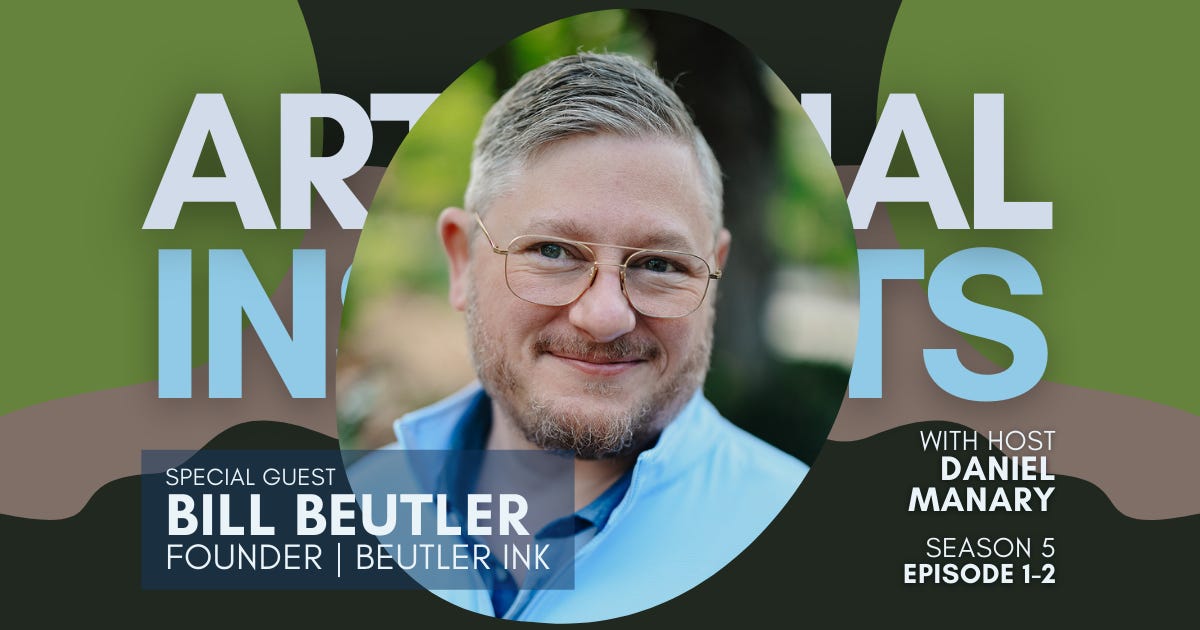
🎙️ Just Interviewed: Bill Beutler on AI’s secret dependence on Wikipedia
At any given time… of all of the citations that appear in ChatGPT, between 5 and 15% of them go to Wikipedia.
Bill Beutler runs Beutler Ink, a digital agency focused on a problem most teams never realize they have: what happens when the public record about you lives on Wikipedia, and you’re not allowed to touch it.
If a company’s Wikipedia page is incomplete, inaccurate, or distorted by old news coverage, the people closest to the truth are also the ones least allowed to edit it. Wikipedia requires disclosure, distance, and patience. Changes must be requested, not made, and approved by third-party volunteers who are trying to protect the integrity of the project. Chances are, they don’t really care about your company.
Bill has worked inside those constraints since 2010, long before AI made Wikipedia newly visible. What changed, he says, is how often businesses now run into Wikipedia indirectly. As AI systems added search and citations to reduce hallucinations, Wikipedia became both a training source and a live reference point in answers. ChatGPT, in particular, relies on it heavily.
Now, many of us no longer visit Wikipedia, even as AI checks it constantly on our behalf. That makes the accuracy and balance of those pages more consequential than they’ve ever been.
💡 One Core Insight: AI Is Eating Its Own Sources
There’s a feedback loop that most of us are already part of, whether we intend to be or not.
Bill describes Wikipedia as a reference layer, not a primary source. It exists by summarizing and pointing to journalism, research, and reporting produced elsewhere. And, that model worked when people regularly clicked through search results, read articles, and landed on Wikipedia pages directly.
But, now, AI changes that behavior.
When answers show up instantly in a chat window, fewer people click through to the underlying sources. That means fewer page views for publishers. Fewer page views mean less revenue. Less revenue means fewer journalists. And fewer journalists mean fewer reliable sources for Wikipedia to cite.
Bill is careful not to claim we are already at the end of that road. But, the direction is clear enough to worry him, and it should probably worry anyone building with AI.
To me, it’s interesting how indirect this problem is. I mean, no one wakes up trying to undermine journalism or Wikipedia. (Well, most people don’t.) We’re just choosing convenience. But the systems we rely on for “accurate answers” are downstream of economic incentives that erode the very sources they rely on.
If Wikipedia loses sources, it cannot verify facts. If it cannot verify facts, it becomes less useful. And if it becomes less useful, the AI systems that depend on it lose one of their most stabilizing inputs.
That makes Wikipedia less like a website you can take or leave, and more like shared infrastructure whose health affects everything built on top of it.
🔑 One Key Clip: Wikipedia’s first competitor… is an AI?
For most of its life, Wikipedia has occupied a strange position online. It has critics, but it has never had a real alternative. Bill’s been saying “Wikipedia has no competitors” for more than a decade, and until recently, that was simply true.
That changed this fall.
In the bonus clip, Bill talks through the launch of an AI-generated Wikipedia alternative backed by Elon Musk. It arrived all at once, with hundreds of thousands of articles, many of them longer and more coherent sounding than their Wikipedia counterparts. For the first time, there is something that looks like a parallel encyclopedia rather than a footnote experiment.
The first question we ask is, “Well, but is it better?”
… Does it matter?
If an AI system can generate encyclopedia-style entries faster and at greater scale, what becomes the role of a human-governed knowledge project? And if multiple AI companies need a shared body of knowledge, do they trust one owned by a competitor, or one that belongs to no one?
Optimistically, Wikipedia still functions as a kind of lingua franca. It is open, freely licensed, and not controlled by a single tech giant. That neutrality makes it usable by everyone. But, it is starting to look fragile.
🥡 One Takeaway: What Are We Letting AI Replace, Exactly?
When AI gives us an answer… what do we think it’s replacing?
Let me explain.
For most of us, it feels like it is replacing search. You know, fewer tabs, less scanning, less clicking around, less reading… That feels like progress. It’s certainly faster.
But, we can’t forget that AI answers aren’t created out of thin air (I mean, even hallucinations technically have a source). They’re assembled from systems that depend on journalism, reference works, and human-maintained knowledge projects like Wikipedia. If those systems weaken, the answers do too, even if that decay is slow and hard to see.
If we stop visiting sources, stop reading references, and stop supporting the places AI learns from, what responsibility do we have for what those systems become, or for whether they slowly fade away?
🥁 Up Next: Dave Boyce on Going to Market with AI
Next week, Daniel sits down with Dave Boyce, one of the people who has shaped how modern SaaS teams think about growth, sales, and renewal.
Dave has built and sold five SaaS companies, but his deeper influence comes from pattern recognition at scale. Through his work at Winning by Design, he studies how revenue systems behave across hundreds of companies, from global platforms like Canva to teams still searching for product-market fit.
If you care about AI, revenue, and durable growth, this is a conversation worth your attention!
✨ When Shared Knowledge Starts to Fray
This conversation with Bill really made me think about the systems I’ve taken for granted, and Wikipedia is one of those systems. It sits beneath search, beneath AI answers, and beneath how many of us come to understand the world. It’s almost invisible.
That makes it easy to forget that shared knowledge doesn’t maintain itself. It requires incentives, attention, and people who care enough to keep it accurate.
I think, if AI changes how we access information, it also changes who is responsible for keeping that information alive.
Do we really want an AI maintaining that body of knowledge for us?
As always, thanks for listening. 🙏

P.S. Artificial Insights is a podcast on how AI is changing work, life—and us. Every other Friday, Daniel Manary sits down with leaders, thinkers, and builders in AI to have candid conversations on what they’re doing right now and how they think the world will change. If you’re a podcast listener, we’d love for you to check us out!
P.P.S. If you liked the episode, please subscribe, share, and or give the show 5 stars. Every little bit helps! ⭐
Artificial Insights is a part of the Manary.haus family ❤️ Come say hi!