


🥰 Greetings! Arianne, here. Editor and producer of Artificial Insights, the podcast. Welcome! This is TL;DL where I write about what stood out to me in each episode, share some food for thought, and do a roundup of what happened and what’s next for those of us who prefer to read.
Let’s go!
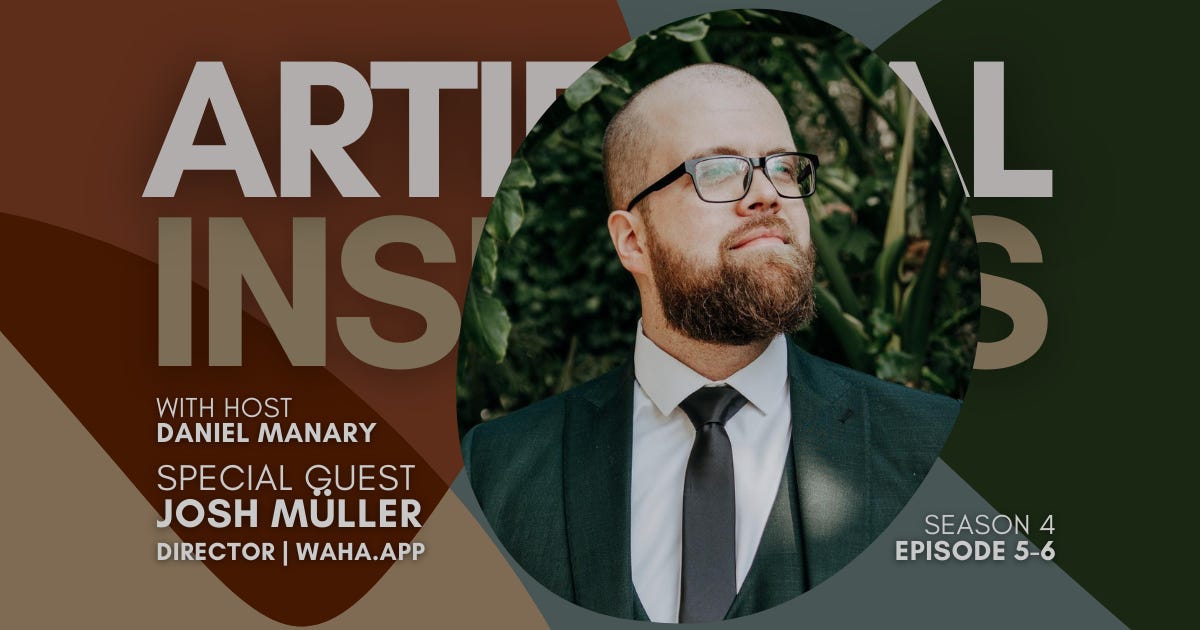
This week, Daniel spoke with someone that I found truly inspiring and one particular story hit me in a way that was quite personal.
In this interview, Josh shared that the idea that unlocked his biggest automation project dawned on him while he was reading his Bible, praying, and enjoying the Lord.
Not during a late-night grind session.
Not during a flow state while working away at a problem.
But, during a moment that felt unhurried. Maybe during a Sabbath.
When was the last time you had a Sabbath?
🎙️ Just Interviewed: Josh Müller on how AI changes what’s possible
So we were able to feed that to our system and now, literally, that six months happens in about 16 minutes of compute time on my server.
Josh Müller is one of the directors at Waha, a tech nonprofit building a Bible study app and curriculum designed to make the Great Commission simple and actionable. Their work right now is pretty intense: they are at 43 languages and trying to reach 100 by the end of next year.
The part of Josh’s story that was so inspiring was how absolute the bottleneck was… it was a limitation that seemed impossible to overcome… until it wasn’t. 🤯
Back in 2019, shipping a full curriculum meant months of manual audio editing. Someone would open an editor, find where each verse started and ended, copy and paste segments, and stitch everything together. It was slow and tedious and it sat in the critical path for getting content into new languages.
Then, Josh had his “Aha!” moment (see above), prototyped an automated workflow, then eventually used forced alignment, feeding text and audio into a model to generate timestamps.
Six months became minutes. A process that used to require sustained volunteer effort became a repeatable compute job on a server.
Think of what that means! 37 new languages in a single year, rather than 20 years. That’s a whole other level of enablement and possibility.
💡 One Core Insight: Margin creates breakthroughs
Josh described the moment the whole solution came together for him while he was using the YouVersion app.
He was listening to the Bible and watching the text highlight verse by verse in real time. Then the thought hit him: if YouVersion can identify where each verse starts and ends, then Waha could, too!
Crucially, it was a reminder about how people work.
This was something that Aydin Mirzaee also spoke about in a previous interview and I think it points to something a lot of teams forget when work (and life?) gets busy:
The breakthroughs you are hoping for, more often than not, need margin.
And for Christians, specifically, it’s a reminder that when we slow down, we are more able to hear God speak and more able to recognize what is actually being placed in front of us.
Yes, AI reduced six months of audio editing to roughly 16 minutes of compute time. But, the deeper win is what that time returns. Josh talked about it as giving people their lives back from work that didn’t need a human in the loop, so they can do the work that actually matters and accomplishes the org’s mission.
That’s a helpful lens for anyone exploring AI.
It pushes you to ask a better question than, “what can we automate?”
You start asking, “what kind of work do we want humans to have time for?”
🔑 One Key Clip: Data stewardship is not optional anymore
For a long time, Josh’s instinct was to keep everything off the cloud. Emails, files, messages. Anything that reduced how much Google or Meta knew about him felt like a win. AI has complicated that stance. The tools become far more powerful when they can interface with your data, but the risks become more real at the same time.
Josh frames data management as a form of stewardship. More than just technical hygiene—it’s also moral responsibility, especially for mission-driven organizations. If you get your data organized well and apply AI thoughtfully, the upside is enormous. If you do it carelessly, the consequences can be just as large.
For Christian non-profits, this stewardship is non-negotiable.
🥡 One Takeaway: Speed changes the rules
Here’s a really cool thought:
Speed changes what is possible and what is viable.
Josh’s example makes that concrete. Reducing a translation workflow from six months to sixteen minutes doesn’t just make the same work cheaper, it breaks the assumptions the organization was operating under.
Goals that once sounded unrealistic suddenly become operational.
A lot of AI conversations get stuck at “AI as a tool” level. How much faster can I write this email? How much better can I summarize this document? But, that’s just scratching the surface! And, most of the time, not even all that net positive.
(Anyone else AI-summarize an email they received that was obviously AI-written?)
What Josh’s work shows is something more foundational. When the entire job fits into the time it takes to make coffee, you can redesign the entire system around it.
That is where discernment becomes important. Speed forces decisions and it should push leaders to re-evaluate where human effort belongs, what constraints are real, and which ones dissolve.
🥁 Up Next: Ahmad Iqbal on who gets to create
The next episode looks at capacity and access through the lens of product design.
Daniel is speaking with Ahmad Iqbal, product lead and Head of MENAP at Canva, about what accessibility really means in an AI-enabled creative platform. Ahmad helped launch Canva’s first generative AI features and shares how simplicity acts as a hard product constraint, not a nice-to-have.
If you’re building products that shape who gets access to creative power, this episode is worth your time.
✨ What we give time to shapes what we see
AI is changing where attention, creativity, and responsibility hang out. When routine effort collapses into minutes, what remains is judgment and discernment. We need to decide what matters enough to act on.
And more than ever, it looks like it’s getting more and more important.
That’s why this podcast exists. We started it to stand at the gate of businesses using AI, separating hype from lasting impact. Josh’s story is a good reminder that the most meaningful uses of these tools aren’t usually flashy.
They’re shifts that return time, restore focus, and create space for work that actually requires people.
As always, thanks for listening! 🙏

P.S. Artificial Insights is a podcast on how AI is changing work, life—and us. Every other Friday, Daniel Manary sits down with leaders, thinkers, and builders in AI to have candid conversations on what they’re doing right now and how they think the world will change. If you’re a podcast listener, we’d love for you to check us out!
P.P.S. If you liked the episode, please subscribe, share, and or give the show a review on your favorite podcast player. Every little bit goes a long way. 😍
Artificial Insights is a part of the Manary.haus family ❤️ Come say hi!